On the map
Where is
Gold Point, NV?
“Chukar and chipmunks outnumber people
twenty to one.
The county said so.”
Gold Point is in Esmeralda County near the California line, eight miles off State Route 266, at about 5,400 feet.
- From Goldfield: about 30 miles southwest, roughly 50 minutes.
- From Tonopah: about 57 miles, an hour and twenty minutes.
- From Beatty: about 66 miles, an hour and a half.
- From Pahrump: about 142 miles, roughly three hours.
- From Las Vegas: about 184 miles, three hours and forty minutes.
Drive times are from a routing service, rounded.
Esmeralda County: Gold Point Travel Nevada: Gold Point ghost townGetting there
Goldfield to
Gold Point.
From Goldfield
Take US 95 south about 15 miles. Turn west on State Route 266 and go about 7 miles, then bear left onto State Route 774. About 7.5 more miles brings you into the middle of town. It is paved the whole way.
From Las Vegas or Pahrump
Go north on US 95, about 15 miles past Scotty’s Junction, and turn west on 266 at the Cottontail Ranch. Then the same: about 7.5 miles, left on 774, eight more miles. The town’s own directions say to top off the tank in Beatty on the way.
In town
The speed limit is 15 mph. Private areas are off limits; stay on the roads when you walk around.
Travel Nevada: take me there Gold Point Ghost Town: directions Travel Nevada: road conditionsComing from the north? Start with our Goldfield guide or Tonopah guide.
Weathered on purpose
Gold Point, Nevada
ghost town.
About 50 buildings still stand on the old main street, many more than 100 years old, including the original post office and the home of State Senator Harry Wiley. Gold Point was never officially abandoned; someone has always lived here. Today it is seven to ten full-time residents.
It survives because of a Las Vegas wallpaper hanger. Herb Robbins and his friend Chuck Kremin found the town in the late 1970s and each bought a building. In 1981 Chuck’s brother Walt joined in, buying the post office, the general store and Senator Wiley’s house. Then Herb hit a mega-jackpot in Las Vegas, and he and Walt bought every building that came up. Friends fixed the roofs and the insides and left the weather-beaten outsides alone, on purpose.
Every building, and every artifact lying in the sagebrush, belongs to someone. Take pictures. The skies are among the darkest in Nevada.
Travel Nevada: Gold Point ghost town Esmeralda County: Gold Point Gold Point Ghost Town: historySagebrush Saloon
The Gold Point
saloon.
“A 1909 pool table.
A 128-pound photo album.
Nobody is in a hurry.”
The saloon is the old Hornsilver Townsite and Telephone Office, moved to its present spot by the owners and turned into a bar. Inside: a 1909 Brunswick pool table, table shuffleboard, and a photo album that weighs 128 pounds and holds more than 8,000 pictures of Nevada mining camps.
It is a private saloon, not a bar with posted hours. Visits are arranged with the owners.
Esmeralda County: the Gold Point saloon Gold Point Ghost Town: the facts Travel Nevada: Gold Point’s Sagebrush SaloonThree names, one hill
Gold Point, Nevada
history.
Lime Point, 1868
Miners found lime deposits here in 1868 and set up a tent camp at a limestone outcrop, mining silver. It was rough going. Freight cost more than $100 a ton, and the nearest water was a day’s wagon ride away in Lida Valley. Better silver turned up around 1880, but the ore had to be hauled to Lida for milling, and the camp was all but abandoned by 1882.
Hornsilver, 1908
The Goldfield strike of 1902 sent prospectors back into the old camps. The Great Western Mine started in 1905, and in 1908 miners found rich hornsilver, a silver chloride ore. The new camp took its name. The Hornsilver Herald started in May 1908, a post office followed a week later, and the town grew to more than 225 wood-frame buildings, tents and shacks, with 13 saloons and about 1,000 people. Claim-jumping lawsuits shut much of it down in 1909; mining started again around 1915.
In 1922 Charles Stoneham of the New York Giants baseball team bought the Great Western at a receiver’s sale. It was Hornsilver’s best producer, with more than $500,000 on the books.
Gold Point, 1930s
In 1927 a miner named J.W. Dunfee went down the mine and came up with a big gold find. Within a few years more gold than silver was coming out, and in the early 1930s the camp became Gold Point. In October 1942 the government’s wartime order shut down gold mines like these, and the miners left for war work. Smaller-scale mining went on until the 1960s, when a misfired dynamite charge caved in part of the Dunfee Shaft at the 1,000-foot level.
The Wileys
Ora Mae Wiley came out from Georgia around 1930 and married Harry Wiley, one of Hornsilver’s founders. He sat on the Esmeralda County board from 1940 and in the Nevada Senate from 1946 until he died in office in 1955. She was postmistress from 1940 to 1964 and kept an eye on the town until she died in 1980, at 83. The post office closed in 1967.
Nevada State Historical Marker No. 156: Gold Point Gold Point Ghost Town: history of Gold Point Travel Nevada: Gold Point historyStay the night in a ghost town
Visiting
& staying.
- Season: open year-round.
- Museums: two small museums, one of them in the old post office, are open to the public most weekends.
- Tours: guided tours of the town and the mill site are by arrangement, or explore the old camps nearby on your own.
- Cabins: the Gold Point Ghost Town Bed & Breakfast rents restored buildings by minimum preservation donation: the two-bedroom Senator Wiley Home, $200 a day; the Radkie House, $190; and two old miners’ cabins, $150, each for one or two people.
- Camping: $12 per person per day, with electric hookups for RVs. Everything is by reservation.
Guests have reported ghostly visits. Jackrabbits are more reliable.
Gold Point Ghost Town: rates and facts Esmeralda County: guest services in Gold PointThe neighbor with the water
Lida,
Nevada.
Lida is on State Route 266, about 11 miles from Gold Point and about 34 miles from Goldfield. Coming from US 95, it is about three miles west of the Gold Point turnoff on 266.
Shoshone and Northern Paiute people gathered in Lida Valley long before the prospectors arrived in the 1860s. Miners organized a district in 1867 and laid out the town in 1872, with stores, stables and a post office. Lime Point got its water here and sent its ore here to be milled; the best ore, worth $500 to $1,000 a ton, went on to Austin or Belmont. Mining slowed after 1880, came back for three years with the Goldfield boom, and faded again in 1907. A small community hung on until World War I.
Nevada State Historical Marker No. 157: Lida Gold Point Ghost Town: Lida and Lime Point
Old silver, new lithium
Silver Peak
& the mine.
“First silver.
Now the battery in your phone.”
Silver Peak is one of the oldest mining areas in Nevada. Ore was found in 1863, the town grew up around a spring in 1864, and a 10-stamp mill went up in 1865 and a 20-stamp mill by 1867. In 1906 the Pittsburg Silver Peak Gold Mining Company built a railroad and, a year later, a 100-stamp mill at Blair. By 1917 the camp was abandoned, and in 1948 the town burned.
The Silver Peak mine
In the 1960s the Foote Mineral Company started pulling lithium from under the floor of Clayton Valley. Today the site belongs to Albemarle, and it is the only producing lithium mine in the United States. Wells pump brine from 300 to 2,000 feet down, four times saltier than seawater, into ponds where the sun evaporates it over months. About 60 people work there.
Getting there
- From Tonopah: about 55 miles, west on US 6/95 and south on State Route 265, roughly an hour.
- Silver Peak to Las Vegas: about 214 miles, a little over four hours.
Clayton Valley Sand Dunes are past town: go through Silver Peak, past the plant, and about 6.3 miles down Oasis Divide Road; the dunes are on the right. Off-highway vehicles may ride the bare sand and must stay on existing roads and trails everywhere else. More in dunes near Tonopah.
Nevada State Historical Marker No. 155: Silver Peak Esmeralda County: Silver Peak Albemarle: Silver Peak BLM: Clayton Valley Sand DunesRide the Pahrump side
Ride the desert
with us.
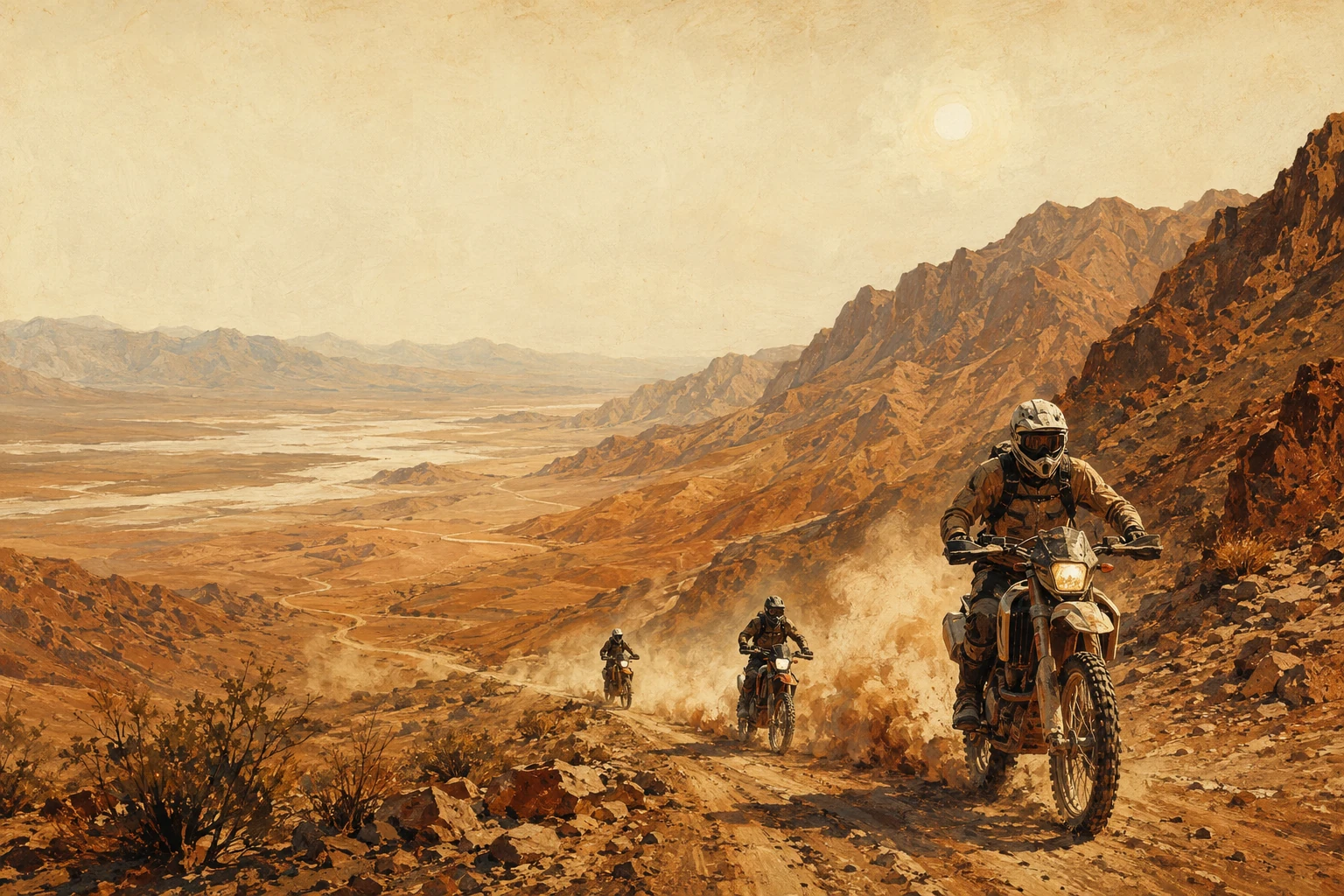
Gold Point is about 142 miles from Pahrump, where our all-day supported ride starts. $399 with a KTM or Husqvarna rental and fuel, or $299 on your own street-legal dual sport. Chase truck, Chef Ruth’s lunch and a beer at the finish. For more old towns on the way up, see Rhyolite, Beatty and ghost towns near Las Vegas.
See the ride ↗